Wednesday, 28 September 2011

SpeedScience @ TechFest Activity WeekEnd

Hello all,
As you all know, dot.rural events attract people people of every age with innovative and interesting activities all over Scotland and the UK.

Over the last couple of weeks the dot.rural team have been involved in different events for TechFest. Gina and Hien represented dot.rural in the Highland Schools Tour... see here for more news. Rob, Leanne and Nimbe brightened up lunch breaks with talks about our cutting edge research in dot.rural, while a number of us were involved in the TechFest Activity Week End in Aberdeen.
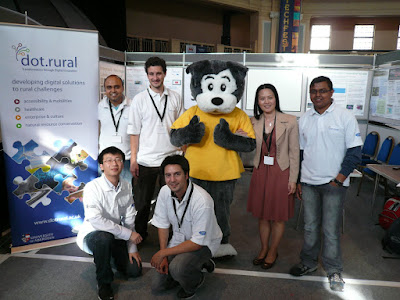


To start with .... What's TechFest in September?
TechFest in September is a festival that aims to promote Science, Technology and Mathematics among young people and the community. Techfest is a great opportunity for dot.rural to show its activities to a diverse audience; from very young children to people of every age and background. It happens every year in September.. and this year's programme can be found here.

... and the Activity WeekEnd?
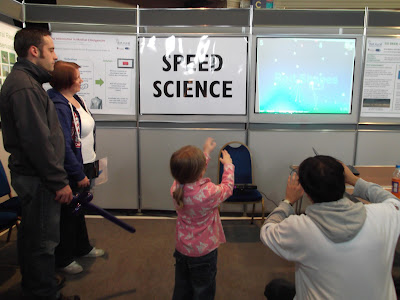
It is an event designed mainly for families that takes place at the Beach Ballroom and Science Stratosphere Centre in Aberdeen. Last year a Technology Museum was built for this occasion by our team. This year on the menu we had SpeedScience a new activity, piloted for the first time in a pub (see here) and re-set for the special audience of TechFest. The idea of SpeedScience is for each researcher to deliver a 3 minute 'pitch' about their research and then hand over to some other researchers. It's a real challenge against the clock, however, given the interest shown by the audience.. for this time and only for this time ...we allowed our researchers to talk a bit longer. The concept remained the same ... a "bite of science", engaging, cutting edge and ....quick!!


Who and How?

Our multidisciplinary SpeedScience team was formed by: Konstantinos, Alice, Andy, John Paul, Henry, Ziaul, Cheng, Nico and Leanne, with additional help from the PolicyGrid researchers: Kapila, Alan, and Thomas, all coordinated by our manager Dr. Yan Wang. The dot.rural team of researchers engaged with over 100 people over the two days and discussed new technologies for rural areas; from healthcare to satellite broadband, trust issues, flexible transportation and so on ....


The interesting characteristic of our audience was their variety - children of every age but also teenagers, parents and adult people.... it was a challenging and interesting opportunity for each of us to rethink and explain our research in a creative way. We had to re-invent the talk for each person in order to make sure that everyone could go home with an idea of what dot.rural is all about in a funny environment.

And here you can see our team in action!!! Ready ...Steady... GO!!! tick tack.. tick tack..


From TechFest 2011

Check out for our next SpeedScience Event in November!!

Friday, 9 September 2011

From Cells to Cellphones

Last week saw the return of the Techfest
Highland Schools Tour.Dot.rural’s Hien Nguyen and Gina Maffey were joined by Sean McMahon to give secondary school pupils a taste of what science has to offer. With a mix of backgrounds in Computing Science (Hien), Ecology (Gina) and Geology (Sean) it seemed natural to explore the importance of an interdisciplinary perspective in science.

As an icebreaker, we asked three volunteers to imagine that they worked in one of our respective roles. We then gave them nine objects that they had to divide among themselves according to whom they thought used the object in their line of work. On offer were a computer, a deer antler, a compass, a fossil, a pair of binoculars, an iPhone, a book on bumblebees, a copy of Microbiology Today and a blood glucose meter. Can you determine who owns which items? Answers at the end of the blogpost!

Having broken the ice and highlighted the importance of looking to different disciplines for creativity in research projects, we aimed to get students thinking about the interaction between humans, nature and technology.


Hien kicked things off with a look at biomimicry and how we can borrow from nature’s design when considering our own technological development. Buildings based on termite mounds, trains based on kingfishers and cars based on yellow boxfish started to get the creative juices flowing. Although, it was ‘rex’ a six-legged robot from University of Michigan and University of California, Berkely, developed from studies of insect movement that captured most people’s attention. Hien rounded off his part with a look at evolution, but not quite as Darwin saw it. He showed how genetic programming can allow a programme to adapt in order to solve a problem, although still within a strict set of rules.


Having established the link between nature and technology it was up to Sean to point out how useful technology can be when trying to understand us. Using the parts of a computer to show how the complex modules of the brain operate, Sean was able to take an intriguing look at the similarities we share. Despite our comparable capacity for memory, problem solving and information movement, many of the students still (thankfully) refused to accept that we are merely computers. This section culminated in an exploration of why we are not just machines, with an all too brief philosophical consideration of human creativity and emotion.


Gina concluded each session by adding the final link to our topic triangle and looking at how technology can impact on our understanding of nature in the future. Before looking to the future students were asked to consider the past with… a toilet roll. 200 sheets of toilet roll were used to present a scale of the 4.55 billion years since the Earth’s creation, with the last 0.5mm representing the 100,000 years that Homo sapiens have been around. Students were asked to consider all the things that we have created or discovered in that relatively short space of time and the subsequent impact that this has had on our planet. To conclude serious consideration was made as to the challenges that scientists face in the future with an inspirational recording about the importance of our ‘pale blue dot’ from Carl Sagan .

The tour visited five schools beginning in the village of Kinlochbervie, before moving to Ullapool, Gairloch, Portree and finishing in Plockton. Without exception each school was welcoming and enthusiastic about the material presented, and we received positive feedback throughout. As presenters there were some intriguing patterns in behaviour with each age group and much to our surprise some of the toughest questions and most thoughtful answers came from the youngest students. We hope that the talk was able to get some individuals thinking about how nature, technology and humans can interact to address some of the problems society will face in the future. We challenge you to let your imagination run wild and think about what technology you would invent to help preserve our planet?


Answers to the icebreaker:

Hien – Computer, glucose meter and a book on bumblebees

Sean – Fossil, compass and a copy of ‘Microbiology Today’

Gina – Deer antler, Binoculars and an iPhone

Thursday, 21 July 2011

docfest: RCUK Digital Economy Summer School 2011

A ten strong group of dot.rural PhD students made their way to Lancaster University to take part in the RCUK digital economy summer school, docfest, hosted by HighWire DTC. With a programme of creativity, risk, leadership, collaboration and serendipitous jelly beans there was something in there for everyone.


DAY ONE: 13th July

Day one began with random groups assigned according to jelly beans distributed as everyone entered the impressive Lancaster Institute for Contemporary Arts building on campus.

Prof. Alan Dix began the activities with a creative angle on critiquing ideas. Distinctly bad ideas were thought up by each group, including, custard bricks, ice pokers and spiky cushions. These bad ideas were then swapped between groups and thoroughly assessed to establish the exact properties that them a bad idea. Flipping things round it was then asked what was good about this bad idea. Readopting these good properties the bad idea was promoted as a good idea.
Any other bad ideas in mind? ...Wind-up fridge, self-lubricating floor tiles, door with hinges on all 4 sides, and the worst mesh condoms... now try to think of anything good about them ?!?!?!?!


In his following lecture Alan emphasised the importance of critical assessment, and really asking what makes your own ideas good or bad. The bad ideas are the sparkling points that allow us to think out of the boundaries and they lead to generate new good ideas. Taking this theoretical understanding and putting it together with a practical application makes for a winning combination in the PhD.

"Blame yourself for what you do, but not for what who you are" - Alan Dix.

Chris Csikszentmihalyi from Massachusetts Institute of Technology used a mixture of amusing anecdotes from his own career to highlight the importance of personal, intellectual and professional risk in the creative process. Chris' talk was followed by a disclaimer that HighWire DTC were not promoting anyone take on activities that would result in arrest during their PhD. This was swiftly followed by a reply from Chris that ' Yes, yes, do get arrested'. With this in mind groups began looking at their own PhDs to ask how risky their ideas were. Discussions then looked at opportunities to increase the level of risk in the PhD, creating a fantasy PhD where anything is possible. Despite the light hearted take on this activity it did highlight the importance of standing back and questioning how much you were pushing the boundaries of your ideas. Chris concluded his talk with a video to explain that taking a risk can be valuable where Werner Herzog is eating his shoe. Werner had promised to “eat his shoe” if Errol Morris would ever finish a film. Well, Morris did it and Werner kept the promise concluding that:

"To eat a shoe is a foolish signal, but it was worthwhile and once in a while we should be foolish enough to do things like that. More shoes, more boots, more garlic." - Werner Herzog

Sir Chris Bonington the mountaineer rounded off the afternoon with an inspiring look at leadership and team work. Giving a gripping account of his trials whilst climbing Everest he demonstrated the qualities of good leadership as well as every team member being aware of each others strengths and weaknesses. Enthused and motivated by Sir Chris' tales we left the session to sit in the sun and enjoy a fantastic BBQ.

"True leaders provide opportunities for others rather than trying to grab them for themselves." - Chris Bonington


After dinner thoughts turned to the future as Mark Huijbregts, the worldwide digital director of Saatchi and Saatchi, explored the impact that the individual is having on branding and design, and ultimately how this is changing the digital realm.


DAY TWO: 14th July

Again jelly beans were the order of the day to facilitate serendipitous connections throughout the day. The mornings activities started with an update on the breadth of intriguing research being conducted across the hubs and digital training centres throughout the UK. This was followed by a lecture from an interdisciplinary artist, Jane Prophet who has collaborated across the sciences, arts and computing to produce a diverse range of visual media. Jane highlighted the importance of recognising creativity and different working practices to make multi-disciplinary collaborations successful.

The final activity for the two days drew on all the topics covered and pitched teams against one another against the clock. Each group was issued with a locked box containing instructions for the rest of the afternoon and a key. The twist being that the key did not unlock the box currently owned by a team. A rapid flurry of box swapping began across the room with the fastest team locating their box in only 5secs! Teams then relaxed a little over lunch to create a Haiku of just 17 syllables, producing a mixture of comical and abstract poetry. After refuelling a fast and furious treasure hunt ensued where teams had to answer a combination of mathematical problems whilst searching for hidden locations around the university campus. With some devious and tactical game play being brought into action there were disqualifications and point deductions dished out. However, the final winning group contained none other than one of dot.rural's newest recruits Danny Heptinstall.

Although tiring, the two days were fun filled and it was great to have an opportunity to stand back and take a look at the PhD from a fresh angle. A big thank you to our hosts HighWire, they will be a hard act to follow at next years docfest.

..happy people at docfest...

and the dot.rural delegation:

Tuesday, 19 July 2011

Café Connect 10 – Tuesday 12th July, Cannich

The final event brings Café Connect to a close (at least for this year).

Dr Sarah Skerratt’s (dot.rural Associate Investigator and Rural Society Research Team Leader, Scottish Agricultural College) talk was held at the fantastic Bog Cotton Café, on the Cannich Caravan and Camping site.


The talk, entitled ‘Rural resilience: Community connections and technologies for tomorrow’, attracted a strong turnout of 14.

Sarah introduced the concept of ‘resilience’ (the “development and engagement of community resources by community members, through strategic means”) and the role of rural broadband within it.

Tying in nicely with her work on the dot.rural DEAR project, Sarah went on to: present a picture of the current demand for broadband, as driven by UK communities themselves; emphasise the importance for communities to understand and categorise their level of resilience, ultimately influencing it, given the government’s and policymakers’ increasing use of the term.


Sarah also referred to the (former) Commission for Rural Communities’ ‘Mind the Gap: Digital England – a rural perspective’ report: “Currently, the incidence of rural home working is as much as three times greater than for urban areas”.

Here are a few examples of successful community-led broadband projects across the UK, which Sarah mentioned:
- Hebrides.net
- Angus Broadband Co-operative Limited
- The Tegola Project (watch our dot.rural seminar on this, by Dr Andy Dearden, here)
- The Phone Co-operative and the Isle of Eigg Heritage Trust

Following this template, Sarah urged communities to state their demand and outline potential benefits when agitating their councillors, quoting the Broadband Delivery UK's plan (to be developed by July 2012).

I finally met Norette Ferns (fellow tweeter, on behalf of SNRNwebsite) in the audience. It was also great to see one lady there after attending the Café Connect in Drumnadrochit the night before – we officially have a groupie!

Sarah’s research normally involves touring Scotland in a camper van for days on end, collecting data. So this, along with her involvement in the Scotland National Rural Network’s Village Halls & Community Buildings Networking event in Birnam, mean she’s no stranger to the Café Connect concept. This all stood her in good stead for the lively discussion session that followed…

- Do/Can communities ‘become’ resilient, or do they start off as resilient? Is it “something a community has, or something they get through fighting?
- Using ‘white space’ technology for rural broadband, i.e. the current trial on the Isle of Bute.
- “Is there a gap between what people want to do/change in their communities, and what they’re actually prepared to do?
- “Online engagement isn’t the only answer for seeding community action – traditional methods (posters, word of mouth etc) are also invaluable which is probably quite a good thing for the communities’ ‘health’.
- Real concerns over the prohibitive cost of satellite broadband provision, and capacity issues as more and more of the community get online.
- Queries over what’s actually possible with high-speed broadband; “what do people do with it?” (linking in with the dot.rural SIRA project’s case study work).
- Concerns over the compatibility and upgrading of hardware to cope with the increasing high-speed broadband provision.
- Expectations of broadband provision, and the differences depending on “where you’ve come from” (if you’re an incomer).
- The increasing focus on ‘remote rural’ areas, but what about the forgotten ‘in between spaces’?
- Issues of capacity/time for effective community engagement; the need for external resource to assist with this.
- The challenges associated with science jargon and the choice of language employed by policymakers and government, i.e. “what does it actually mean – in terms of download speeds etc – to go from, say, 2 to 4 Mbps?

Special thanks goes to Fay Jones (the Cannich champion), Ian, Edward and Robbie for their contributions to the debate.


So, after 10 events, in 10 communities, in 10 days, what’s the verdict? I’m exhausted but it’s definitely been worth it. We’ve had 6 (out of the 10) undoubted successes, with between 13 and 24 people attending (that’s more than 16% of the local population in some cases!).

And BIG thanks to Aileen for booking the (TEN!) ferries and the B&Bs, and to Mat for being 'chief bannerstand setter-upper' and for driving most of the mammoth 1429 miles!

What’s next? I’ll be evaluating the pilot and composing a report shortly for dot.rural and the Scottish Government (i.e. the funders!). After that… hopefully Café Connect will be back next year! In the mean time, please feel free to comment on any of the blog posts.

Claire *collapses*

p.s. here’s a little something for Rene, and the rest of the Digital Conservation project team, to appreciate…

Monday, 18 July 2011

Café Connect 9 – Monday 11th July, Drumnadrochit

9 down, 1 to go and we’re flagging… just a tad! (Who’s idea was it to do 10 events in 10 days, across Scotland, again?!)

Leaving Eskdalemuir (and the trauma of last night’s feathery casualty) behind, we headed north to Drumnadrochit. Seven hours later, we’d arrived along the banks of Loch Ness.

The Drumnadrochit champion and Centre Co-ordinator at the Craigmonie Centre, Fran Davidson, gave us a quick tour of the Glen Urquhart High School (integrated with the community centre) before setting up.


Fran did a super job maximising the attendance from around the Loch, using both traditional and social media tools. She even targeted the local MSPs, including Danny Alexander. Unfortunately none of the politicians invited could make it on the night.


Dr Lizzy Tait’s (dot.rural Impact Assessment Research Fellow) thought-provoking talk, entitled ‘The Power of Social Media: Transformational tweeting or devaluation of democracy?’ pulled in the crowds at the Craigmonie Centre: 18 people to be precise.


In the true spirit of the night’s proceedings, I was tweeting throughout, incorporating the central element of social media…

''social media is just 1 contributing factor, in a mesh of interactions, in recent political revolutions'' #CafeConnect bit.ly/iN9Bhw

In a political bubble? Does social media re-enforce political beliefs, or broaden them? #CafeConnect bit.ly/iN9Bhw

Tonight's 'social media' #CafeConnect bit.ly/iN9Bhw: @theSNP's are most active party with social media...

No one in tonight's 'social media' #CafeConnect bit.ly/iN9Bhw audience is a member of a political party

Social networking accounts for approx 1/4 of all time spent online... #CafeConnect bit.ly/iN9Bhw

if a political candidate's on twitter, r u more likely to become politically engaged with their party/agenda? #CafeConnect bit.ly/iN9Bhw

Using Internet techs to help promote political views is nothing new... #CafeConnect bit.ly/iN9Bhw

RT @dannyalexander just about to kick off with drumnadrochit #CafeConnect bit.ly/iN9Bhw -shame you couldnt make it!

just about to kick off with drumnadrochit #CafeConnect bit.ly/iN9Bhw follow our live tweets!


Lizzy’s talk stimulated great debate from the audience, including…
- Within the NHS, the (almost) instantaneous sharing of information raises challenges surrounding information accuracy and privacy.
- Two worlds colliding with the increasing impact of social media on mainstream, traditional media: “a good supplement but not a full replacement”.
- The possibility of social media replacing newspapers, but not journalists. Without these, you lose some level of political analysis.
- Twitter as a signpost, a gateway; “a blog without a twitter feed is like having a restaurant without a sign”.
- Political parties have been slow in adopting social media and haven’t used it as intended, i.e. to distribute small bits of information, quickly.
- The dangers of politicians abusing or exploiting demographic information contained within social media networks.
- NodeXL: A network analysis software tool which doesn’t collect demographic information… yet.
- Social media in rural areas has become the ‘hub’ for up-to-date, accurate information in dynamic situations such as school closures etc.
- The influence of social media: “a network is not proportional to the number of people following you, but the number of people following them…
- The importance of political parties engaging people, through social media, on a local, not just a national, level.
- Concerns over accessibility and digital exclusion, with new technologies possibly not being able to reach everyone, everywhere (due to cost or distance).
- The contrast between tools such as Facebook (more private? requiring a ‘real life’ interaction first?) and Twitter (the opposite?).
- Social media (about free will, autonomy, individuals) vs. political parties hierarchical organisations): does the mass adoption of social media pave the way for more independent politicians?
- The impact of social media when raising awareness about large companies and revolutions (are these just protests, without inducing actual change?).
- The power of the 'retweet' (RT)!
- Political institutions are built on an old model of trust, and the ability to gain public trust has changed through social media. At what point does a regular tweeter become a ‘politician’? e.g. Ben Goldacre, creating ‘policy’ through discussions with ‘followers’.
- Social media as “profoundly democratic”, with “my tweet being just as valid as the next persons”.
- “The whole point of social media is the conversation.
- The positive, ‘serendipitous effect’ of social media: perhaps you experience an awkward, and seemingly pointless introduction to social media, but then find a positive and relevant use for it.
- The simultaneous engagement between TV (old media) and social media e.g. #bbcqt
- Is social media making democracy more, or less, robust? Well that depends on what you mean by ‘democracy’…

Finally, special thanks go to the following for great contributions to the night's discussions: Rene Looper, Miles Mack (a GP from Dingwall), Rab Gordon, and Morag from the Enterprise North East Trust.

One left: Cannich tomorrow. I can’t believe the end is in sight.

Claire

Café Connect 8 – Sunday 10th July, Eskdalemuir

Day 8 and its just a short drive from New Galloway to Eskdalemuir for the next instalment of Café Connect.

Eskdalemuir has one big claim to fame: its home to the first Tibetan Buddhist temple in the West… The Kagyu Samye Ling Tibetan Buddhist Centre.


Our hosts for the evening, the Upper Eskdale Develeopment Group (UEDG), coordinated a petition, ultimately convincing the council to sell the Old School (or ‘Hub’) to the community last year… for the bargain price of £1! The UEDG are now busy making plans and writing funding proposals to redevelop and extend the Hub.

At the venue (the Hub, not the temple!) we saw a great turnout (16 people) as the UEDG rallied around, fully supporting Café Connect.


Dr Advaith Siddharthan’s (dot.rural Natural Resource Conservation and Computing Science Associate Investigator) talk, entitled ‘Citizen Science: Conservation research is in your hands’, began with a light introduction to the world of citizen science (‘Citizen’ referring to the element of democracy and participation).


Advaith named GalaxyZoo as a popular example of a well-established citizen science project, utilising crowd sourcing.

He went on to point out that the history of Computing Science mirrors that of Citizen Science, spanning Distributed Computing to Brain Sourcing/Human Computation (the technology behind e-Science).

It seems that the field of Natural Resource Conservation has a long history of public participation, e.g. the activities of the British Trust for Ornithology (BTO) and the Royal Society for the Protection of Birds (RSPB).

Advaith’s talk described dot.rural’s Digital Conservation project, involving the Bumble Bee Conservation Trust's Bee Watch, asking:
- How can we motivate people to engage with Bumble Bee conservation?
- How do we sustain this motivation? Through user-specific feedback, online games, creating online communities etc.
- Is such a project scalable?

Advaith’s interactive ‘identify the Bumble Bee’ exercise sparked some lively comments: “Its great just to know there are so many different types!”.


I couldn’t help wondering why I, and the rest of the University’s Public Engagement with Science Unit, haven’t been more actively involved in this project – the fit seems obvious. Also, I now have a plan to unlock some Partnership Resource funding and launch a schools competition around Bumble Bee conservation!

A summary of the lively discussions that followed the talk…
- The ‘hooks’ for motivating people are, essentially, communicating and understanding the life-changing impact of not acting and not conserving species, “getting people early on in life”, and communicating the final research outputs back to the public(s).
- Tales of being involved in AuroraWatch – a system, which alerts members, enables sharing of photographs, and (crucially) feeds back to users after recent activity – and their successful, personal and community-building approach: “The more we engage with them, the more they engage with us”.
- Awareness of the current Bugs in Gardens Dumfries and Galloway project whereby members of the public are encouraged to record the bugs they find in their gardens.
- The wildlife recording exhibition about to open at the Tullie House Museum, Cumbria – “an old fashioned type of engagement”.
- The need for people to not just collect data, but also, to ask questions! i.e. the Wild About Britain forum - an online community of over 40,000 members.
- Awareness of the Woodland Trust’s management schemes.
- The role of narrative and art in getting children involved in conservation; “don’t think of this as a science”, “perhaps its part of the wider learning experience”, tying in with Scotland’s Curriculum for Excellence. In which case, who’s responsibility is this? Is there a need for a whole new cohort to deliver such engagement?
- Apply the methods and techniques young children use when engaging with each other, virtually, to motivating people to do conservation and citizen science.
- Queries over “where the science in citizen science is”.
- Questions surrounding image-recognition technology: Although not the goal of citizen science, if a computer can recognise an image of a bee, or a bird, automatically, where’s the need for an enthusiastic and engaged public?

Big thanks to Jock Miller, Nancy Chinnery and the rest of the team for the fanstatic hosting (and cakes!)…


It was unfortunate that the Eskdalemuir champion, Nick Jennings (Chairman, UEDG), was unable to make it due to illness. Nick did a great job in the run up to Café Connect, spreading the word. As it turns out, his marketing strategy was superbly targeted, with a whole bunch of enthusiastic and professional ecologists in the audience!

Some members of tonight’s audience included…
- Teresa (Statistical Ecologist) and Mustafa from the Cumbria Biodiversity Data Centre (find them on Facebook here).
- Fiona Russell (Ph.D. researcher at Glasgow University) working in the field of Eco-Criticism and Eco-Poetry!
- Chris Miles (Scottish Natural Heritage Area Manager for Dumfries and Galloway).
- Tim (Woodland Sites Manager, the Borders Forest Trust).

On the road back to the B&B in Langholm – with a novel alternative to wifi (wireless Internet signal from the mains Earth!) – we managed to dodge two birds, a hare and a fox… unfortunately, we couldn’t miss the final obstacle; a barn owl, frozen in the headlights. If only we had some of these

Claire

Café Connect 7 – Saturday 9th July, New Galloway

Another early start and another ferry (this time Craignure-Oban) was followed by a long drive down south.

We headed to Kitty’s Tearoom for a pre-Café Connect dinner – if you’re looking for the best traditional tearoom in the UK, this is it.


En-route we spotted the Galloway Kite Trail. Something for me to report back to Dr Rene van der Wal (dot.rural Natural Resource Conservation theme Lead) for the Red Kite project…


Today’s venue? The fantastic CatStrand ("contemporary performance and meeting space"), New Galloway…


Prof Dave Godden (dot.rural Healthcare theme Lead and Co-Director of the Centre for Rural Health, University of Aberdeen) delivered his talk entitled ‘Rural Emergencies: New technologies to aid First Responders’, linking in with our MIME (Managing Information in Medical Emergencies) project.

Quite appropriately, the audience included a Mountain Rescuer and two First Responders.

Dave outlined the changing landscape of healthcare providers, emphasising that its dot.rural (and other research centres) who strive to develop new technologies but it’s the policymakers who, ultimately, decipher the extent of their uptake.

The technology priorities to assist the first person on the scene of an accident: design a device to help decision support in real-time; use the device to monitor the patient’s status whilst being transferred; use the device to accurately collate, conserve and forward the ‘information trail’ gathered over the whole rescue period (using Natural Language Generation). In practice, the design of such a device raises issues of weight, portability and battery life, amongst others.

Dave's 'demo'…


The discussions that followed included…
- From the research point of view, dot.rural are thinking ~10-15 years ahead when designing such technologies.
- In any emergency, there’s a whole chain of people involved during the patient’s transfer. Thus, inconsistencies and mis-information in the information trail are inevitable. Therefore, the aim is to improve on the paper and pencil system currently used, often completed after the event, while considering environment-specific factors such as noisy, dangerous and wet scenarios.
- Accounts from the audience on the value of technology to support First Responders: “there are people who would be more likely to be first responders if some sort of tech was available to support”. Followed by caution from Dave over creating a false sense of security, with the need for basic skills and training not to be replaced.
- Concerns over signal coverage in remote and rural areas and the dependency of such devices on infrastructure.
- Issues of knowing how much data to send on to the respective hospital when monitoring the patient and the impact on information flow.
- Worries over whether the stick-on monitoring pads interfere with a defibrillator and can cope with exceptionally hairy people (they can!).
- Emphasis on the need for training, to support the uptake of devices, whatever the technology.
- Queries over the testing the device; Simulated data is being used in the R&D phase, before being used on real patients - ultimately, real data-sets are required.
- In paperless scenarios where First Responders are asked to justify their advice or actions, there could be a place for new technologies to help.
- Currently, there’s no formal feedback process so, once the patient has arrived at the hospital, mountain rescue teams/First Responders are not updated on their progress or the final outcome. Perhaps new technologies could be used to relay what this information, especially for future training purposes.

This was Dave’s last ever, public talk before retiring from academic and clinical work, later this month. As he embraces retirement and pens his long-awaited first novel, keep your eyes peeled for D. Godden on the shelves of all good book shops…

Claire