Monday, 11 July 2011

Café Connect 4 – Wednesday 6th July, Isle of Barra

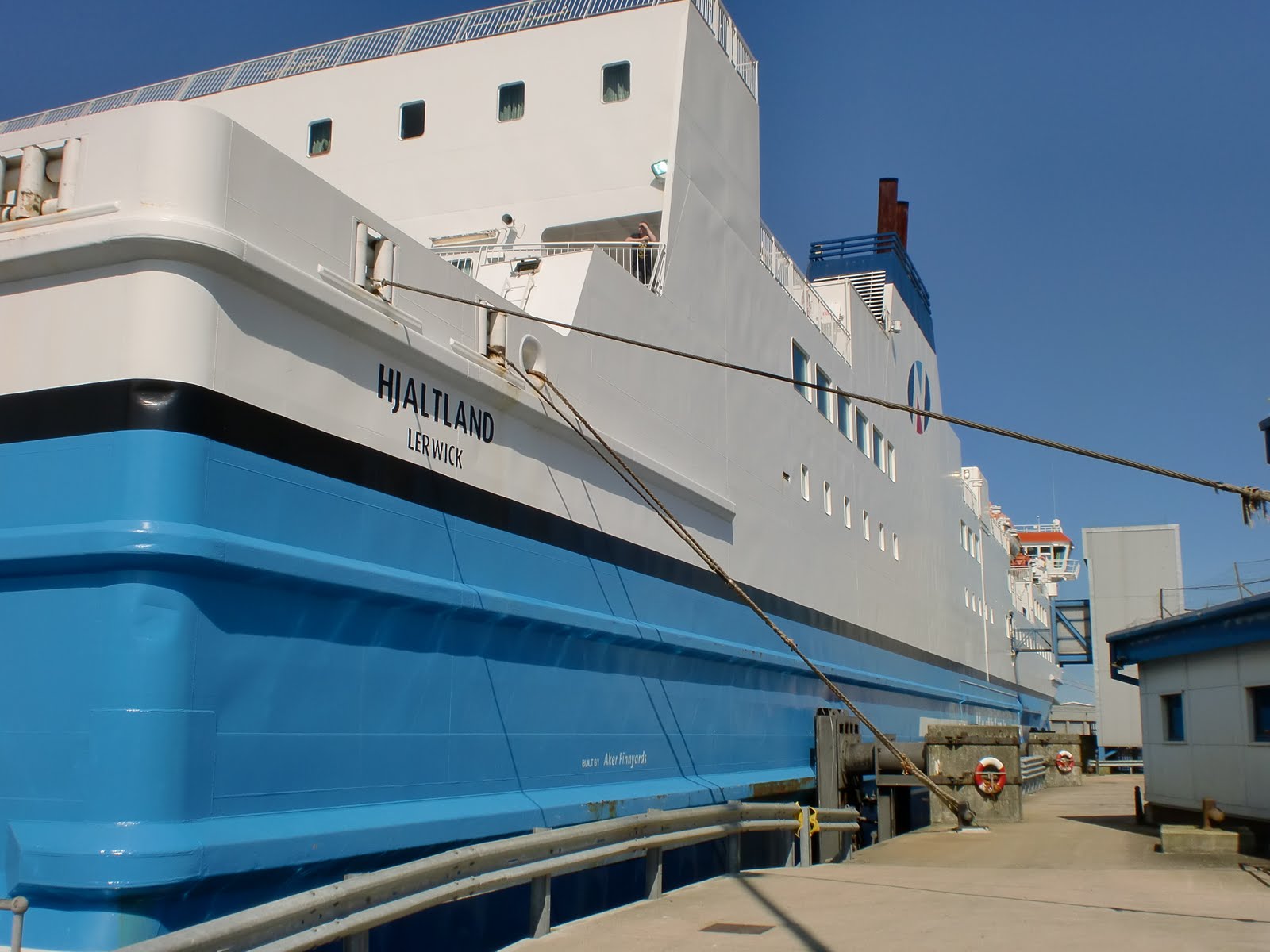
Leaving the peat bogs of Lewis behind, I headed south via the stunning beaches of Harris, to catch the first of three ferries for the day (Leverburgh - Bernerary) with no contingency built into the schedule…


…and then through North and South Uist to catch the second ferry (Eriskay –Ardmhor, Barra). When checking-in at Eriskay I noticed a local flyer advertising the ‘Mobile Chippy Bus’. Genius.


Once on, I spotted some 'Flexible Integrated Transport Services' in action! The Grillburger van man was distributing his deliveries to other (non-food business) drivers on the ferry, for wider circulation afterwards.


On the ferry some eager passengers pointed out basking sharks – with the Captain halting the ferry mid-crossing, allowing them to pass – and later, a group of seals.


Once on Barra, and with minutes to spare, there was no time to hop over to Kisimul Castle…


… before locating the elusive ‘Youth Café’ hidden within the Community Hall and the not-so-elusive speaker, Ruth Wilson (dot.rural Enterprise & Culture Postgraduate Researcher).


The champion, Murdo, eventually located the keys to the Hall and Café Connect number 4 got underway.

Unfortunately Ruth delivered her talk, entitled ‘Facebook and the Fate of Barra: The digital evolution of social life on a small island’, to one of our smaller audiences – in the rural locations we’re reminded that it really is all about quality not quantity – but stimulated, undoubtedly, the most interactive and in-depth discussion to follow a talk.

Perhaps it was the earlier start time (all other Café Connects commenced at 7 pm, unrestricted by the ferry timetables), or that such an initiative is new to Castlebay, or the fact that the social media networks weren’t fully utilised locally (i.e. the Siar FM Facebook page) beforehand...

With fantastic input from two members of the audience, Jane and Peter, the following points were raised during the 90-minute discussion:
- The impact of the Internet in the media, e.g. the Pope’s first Tweet.
- “Whatever wonderful things the Internet might bring, a hug is not one of them.
- Isolation, community and well being all supported (or not) through social media platforms such as Facebook.
- The different uses of social media in remote and rural areas, compared with towns and cities, and its affect in weakening/strengthening community.
- Parallels with the introduction of previous communication methods (such as the telegram, the telephone…) receiving similar receptions.
- The blurring of social lives; where does one end (‘real’ friendship) and the other (online relationships) being?
- Examples of local uses of Facebook included playing scrabble with relatives living in other places, and connecting with other, similar businesses (in this case a network of proofreaders).
- Those living on Barra not really considering themselves as ‘remote’.

It was also great to learn that Barra boasts an avid group of ‘Bumble Bee counters’ (something which may be of particular relevance to Dr Rene van der Wal and our Bumble Bee, Natural Resource Conservation project) and the suggestion to explore potential collaborations with the Co-operative.

From these discussions with real end users, there’s no doubt that Ruth’s research has been actively shaped.

It already appears that the audience turnout is directly dependent on the efforts of the community champions, and is inversely linked to the local population size; the fewer people in the community, the stronger the community networks and thus, the greater the demand and demonstrable support for such initiatives. After today’s Café Connect, it also seems that a smaller audience fosters more engaging, and multi-way, discussions.

So, what next? Another ferry! We boarded the Castlebay-Oban ferry and once we’d set sail, we were closely tailed by a group of playful dolphins.

How much can you squeeze into one day? 226 miles, three ferries and a Café Connect.

Claire

Thursday, 7 July 2011

Café Connect 3 – Tuesday 5th July, Isle of Lewis

Tuesday kicked off with an early-morning drive from Bonar Bridge to Ullapool in time for the ferry to Stornoway and to meet up with tonight’s speaker, Dr David Corsar (dot.rural Computing Science Research Fellow).


Once in the Outer Hebrides (for the first time!) we popped in to the famous Charles MacLeod butchers for a Stornoway black pudding (or 3!)…


…ticked off another stone circle at Callanish and went into the blackhouse at Arnol… and came out smelling like a kipper!


Thought for the day: Forget me, more importantly, how long can a black pudding survive on the road?!

The Ravenspoint Café Connect community champion – John Randall (Chairman, Co-Chomunn na Pairc, the Pairc Community Co-operative) – cleverly tied in our talk date with the launch of the brand-new extension to the Ravenspoint Community Café.


The café, funded by Big Lottery Fund, HIE and CnES, is the latest addition to the Co-Chomunn na Pairc community enterprise. Locals and tourists can also find the Ravenspoint community shop, museum, archive and hostel on site.


The community turned out in full force, supporting John, the new café extension and the Café Connect pilot. During the speeches and obligatory ceremonial ribbon-cutting…


…the supporters were literally queuing out of every doorway.


David delivered his talk on ‘Driving Rural Transport: Mainland technologies for a small island?’ to a 24-strong audience!

David introduced the two dot.rural Accessibility & Mobilities projects, FITS and IRP, proposing that the Q&A session that followed be used to discuss the demand for, and applicability of, such initiatives within the context of island communities.


Tonight’s Café Connect turned out to be our most successful one yet. The audience was sizable – given these are all taking place in remote and/or rural communities – and demographically varied. Attendees included Donnie Morrison (Director of Co-Chomunn na Pairc, the Pairc Community Co-operative and HIE employee), Helen (Community Development Officer) and Malcolm Burr (Chief Executive of the Western Isles Council).

The Q&A session prompted lively discussion and lots of comments for me to feedback to the dot.rural researchers, potentially shaping the research. The venue (and the views!) was superb and there was a real sense of occasion.

A summary of the discussions…
- Reassessing the community bus use (expertly spotted beforehand by David, parked outside) which is currently estimated to be in use ~<5% of the time!
- Utilising the current hospital transport provision to maximum effect
- Concerns over the cost of fuel and the socio-economic impact on rural transport services
- The idea of having one ‘shared’ car per village, or even investigating what the optimal number of shared cars per village would be.
- The tensions of cheapened transport provision vs rural development and the potential (negative) socio-economic impact, e.g. free/subsidised transport to supermarkets in larger villages and towns reducing spend in community shops
- Looking into the introduction of ‘driver incentives’ (“driver is key”) when relying on goodwill is not sustainable.
- An idea of the timescales involved when tailoring such systems to each individual community.
- Issues over the legalities and ethics associated with FITS-type schemes and wider concerns for the ‘disengaged’, those who are not computer literate or who chose not to be digitally involved.

One member of the audience, who may turn up at Lizzy Tait’s ‘Power of Social Media’ Café Connect in Drumnadrochit on Monday 11th July, recorded the audio of David’s talk…

I managed to get online briefly (if I lived in the Outer Hebrides I don’t think I could ‘live’ without an iPhone) and finally tweet.

Unwinding over a couple of bottles of Celtic Black Ale back at the spotless Loch Erisort Inn, I knew that, if nothing else, the Café Connect principle has been proven tonight through this success at Ravenspoint.

Over the Café Connect series, I’m becoming more and more convinced that the success of such a pilot, and any follow-on initiatives, hinges on the champion; their place within the local community, the connections they have and their efforts invested in promoting the event locally beforehand. John has been an absolute star.

I’ll definitely be back. If not to stay in the Ravenspoint Hostel and (re!)sample the fantastic cupcakes, then to catch-up with John.

What’s the most impressive part of the evening? Being privileged enough to see such a focused and community-spirited group of people working together towards common goals.

Sadly there’s no time to see the looms weaving Harris Tweed with this gruelling schedule. Tomorrow, three ferries, a Café Connect in Castlebay and a 5.30 am start to check out the Harris beaches all lie in store. Yawn.

Claire

Café Connect 2 – Monday 4th July, Bonar Bridge

Arriving in Scrabster I thought it was only right to ‘tick off’ the most northerly point on mainland UK; John O’ Groats.


Not only is John O’Groats the most depressing and toot-tastic place in Scotland, it turns out its not even the most northerly point. In both the natural beauty and the northerly claim-to-fame stakes, Dunnet Head wins.


Dr Arjuna Sathiaseelan (dot.rural Communications Engineering Research Fellow) led the second Café Connect talk on ‘Pervasive Internet: Rural reality or pipe dream?’ at the Bonar Bridge Community Hall, with free tea and biscuits laid on.


Arjuna’s engaging talk spanned the complete evolution of the Internet as we currently know it; the difference between the internet and the Internet; and what the online future promises.

He also suggested that satellite technologies, although often seen as a last resort for fast, next generation connection, may actually be an appropriate option for remote and/or rural communities (linking into the dot.rural SIRA, DART and ASSURE Enterprise and Culture projects).


The lively debate that followed included…
- Issues associated with satellite broadband: What happens if a sea gull lands on your satellite dish? Will a satellite Internet connection still hold out during heavy snowfall?
- Real concerns regarding the affordability of satellite broadband for an area like Sutherland with lower than average salaries: An introductory price of ~£30/month was deemed too high, even for a converged (e.g. TV, radio, telephone and broadband) service.
- With Sutherland being the “least populated area in Europe” (~1 person/2.2 square miles) what alternative broadband technologies are feasible for local communities?
- The frustration experienced with current download speeds and concerns over any potential impact on feelings of isolation associated with a change to the current broadband provision.

John McMurray (Community Outreach Worker, Bridge Project, Dornoch Firth Group) attended the talk and, as a result, is particularly keen to liaise with our dot.rural Co-Investigators leading the SIRA project (Prof Claire Wallace and Prof Gorry Fairhurst) exploring potential community case study opportunities. John also mentioned similar community initiatives such as Cybermoor and Wray (both well known to dot.rural) and the Renfrewshire Council of Voluntary Services’ broadband project (previously off dot.rural’s radar!).

Quote from an audience member: “Its not the technology that matters, it’s the way people use it.”

Claire

Café Connect 1 – Sunday 3rd July, Kirkwall

Dr Rene van der Wal (Reader at the University of Aberdeen and dot.rural’s Natural Resource Conservation theme Lead) kicked off the Café Connect pilot series in the awe-inspiring setting of St. Magnus Cathedral, Orkney with his talk entitled ‘Birds, Bees and Digital Conservation’.

I (obviously!) know Rene’s an ecologist but, still, his passion for birds really struck me on the ferry from Aberdeen; while everyone else was (unsuccessfully) battling with the inevitable seasickness, Rene set up camp at the stern, bird spotting armed with binoculars and his ears acutely tuned to squawks.


Before the talk, I squeezed in a quick visit to the Tomb of the Eagles and the Neolithic village of Skara Brae, shamelessly spreading the word en-route!


A slight ‘teething problem’ [no banner stand pole] meant we resorted to tying the dot.rural banner stand… to the pulpit!


Despite the cheesy sound bites on BBC Radio Orkney beforehand, the turn out was lower than expected; perhaps due to the distracting sunshine that day, or maybe the fact that one-off pilot initiatives, by definition, haven’t yet built up a known and engaging brand within the local area…

Nevertheless, Rene’s talk was superb – asking whether digital innovation can inspire, or even re-connect people to our natural environment – detailing the dot.rural NRC projects on red kites and bees, complete with an interactive ‘identify the bumble bee’ exercise (c.f. the dot.rural bee project).

The audience included representatives from the Orkney Field Club (Penny) and the RSPB (Kenneth) volunteers. Hence, when combined with the talk topics, the Q&A session ventured into discussion of: OrkBird, a well-established, local bird identifying and audio/visual recording community database, similar to iSpot; the potential sociological impact(s) of crowd-sourcing methods; the challenges associated with working within such an interdisciplinary research group; and the importance of such community initiatives in maximising the involvement of people in the different layers of natural conservation. There was also lots of discussion of how the school communities and voluntary organisations of Orkney can get involved with the red kite story-telling and the bumble bee recording projects, respectively.

The night ended with a fascinating impromptu cathedral tour from Fran with her excellent and very animated storytelling, revealing the hiding (and final resting) place of St Magnus’ remains – hint, look for the marked stone in the south-east pillar – and bringing the legends to life.

As the sun was setting we headed to the standing Stones of Stenness…


…and the Ring of Brodgar where Rene suggested I eat (yes eat!) some Bell Heather…


…before preparing for an early (5.00 am!!!) check-in for the Stromness-Scrabster ferry on Day 2.


Claire

Thursday, 9 June 2011

Enterprisers

Enthusiasm,
Networking,
Teamwork,
Energy,
Relax,
Passion,
Regeneration,
Inspiration,
Satisfaction,
Engagement,
Reflection,
Sparkle
....and more and more....
...what's that? It's only a little part of what you can get from Enterprisers.
What's Enterprisers? It is a programme run by the University of Cambridge.
It is all about developing entrepreneurial skills, from creativity and marketing to communication. However, there are loads of other exciting things that one can learn and practice. More information can be found in Enterprisers.

This course is perfect for people interested to start a business but anyway this should not stop others to participate because the skills that you learn and practice are useful for all types of jobs.

Anyway after attending the workshop last week in Cambridge I can tell you that this is not only about skills, it's a change of life...
I will not describe what activities we have been doing because otherwise I will ruin the surprise effect but I can tell you that you will find yourself doing all sorts of activities, playing, acting, dancing, singing, eating, thinking, presenting without even realizing it.
And I'm sure there is something useful and funny to bring home for everyone.

...It's been a week and I feel like it happened only in my dreams... such amazing people, an incredible team "Green Stars", interesting entrepreneurs with different stories, a great group of facilitators and the two most amazing mentors we could have ever had...

The workshop is a really intense 4 days journey but at the end you feel like you have been away for months. It started with a deep work on ourselves, our objectives and motivations and by the second day I had forgotten all the dark days of my PhD :) :)

The best point is that I didn't realise how much I learnt in such a short period of training. Although the usual training courses are interesting I found most of them a bit "boring" ....but this one is just so dynamic and funny and extra-creative and.... just great! And I was so lucky to be in the Green Stars team, they were extraordinary and we have been working very well together... And here is our amazing GREEN ROCKET ready for the moon!!!... keep dreaming!!


It's been a very refreshing experience, it's good to change environment and meet such great people, it's been an explosion of positive energy and enthusiasm. When you are overwhelmed with many things to do it's likely that you forget the motivation that inspired your choices in the first place... Well this course has helped me to rediscovered the motivations for which I started my PhD....


A big thanks goes to the Green Stars which have made my experience just Amazing!!!


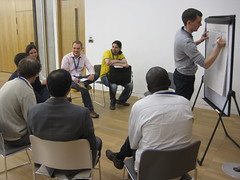
And here some pictures of our work in progress... (Giant Jenga and Brainstorming)


...And the launch to the Moon.....with Parachute....


Alice

Thursday, 26 May 2011

SICSA PhD Conference 2011

Hello All,

After our riddle, I'm now sure you are all keen to know what the SICSA PhD conference is. SICSA stands for Scottish Informatics and Computer Science Alliance and involves all the Computer Science and Informatics departments in Scotland. The Phd Conference is done by students for students. It is a great opportunity for all PhD students of these universities to meet and discuss about their research as well as participate in workshops and talks from experts in the computing research community. The conference is organised by enthusiastic PhD students in collaboration with a team of passionate professors, lectures, officers and assistants.


Enough with the technical details, you can find more in SICSA and SICSAconf, and let's talk about the WONDERS of this year conference.

The conference took place in the Informatics Forum, University of Edinburgh, from Monday the 23rd to Wednesday the 25th of May 2011. Theme of this year: "Does our computing research have an impact on society at large?". Andy, Peter, Toni and I went along with other six students from the Computing Science Department of Aberdeen University.

The conference opened Monday with a warm welcome from Prof. Ian Sommerville and Prof. Rod Murray-Smith, followed by a brilliant talk from Prof. Harold Thimbleby on "Secrets of successful research". Few of those: read at least five theses, start to write your own now, broaden your understanding of the subject through the help of a mentor more aligned with your topic of study or visit someone whose research you admire...

… a secret was missing though... what is the Inspiring Muse of each PhD student? Where did you have your best brainstorming ever? The answer is … a Pub Session!! To comply with this PhD survival norm we hired out the local student bar (the Tron) for the evening. Great opportunity to socialise and discuss about the hidden secrets of computer scientists cheered up by two comedians from the local comedy scene of Edinburgh. On the menu Tennent's, Python, weddings, Talisker, p=?np and much more...

Tuesday was the workshop day. Transferrable skills talks in the morning and four societal challenge in the afternoon. Green IT, Collective Intelligence, Security and Digital Inclusion with over 20 panelists discussing about what are challenges of today's society. How can computers encourage individuals to lead a more "green" lifestyle? How can we improve the integration of new information technologies on the modern society? How can we deal and prevent cyber attacks on secured information? How can we incorporate collective intelligence for useful purposes? If you want more information check out the slides here . A note to remember that dot.rural and Aberdeen Uni were well represented by David Corsar with his talk on "The collectively informed (and intelligent) rural passenger" and Edoardo Pignotti with "Collective intelligence and provenance in digital social research".

And then off to the dinner in an amazing place called 'The Caves" in the heart of Edinburgh's Old Town. Good food and good wine, all accompanied by a talk from the writer Ken MacLeod on robots and Artificial Intelligence from a SciFi point of view.

Throughout the conference, over 80 posters had been presented. This was an excellent opportunity for every student to engage in discussions with other students working on similar projects but also to get to know different aspects of the computer science research. And (if I may add) to understand that we are all on the same boat... fighting to find our spot in the community :P !! A competition among posters took place as incentive to contribute in this think tank. The competition ended with 11 finalists and 2 best poster winners. The good news is that three people from Aberdeen Uni made to the final. Two of them made dot.rural proud!! Andy with his poster on "Preventing Profiling in Competitive Communities" and Peter with "Alleviating stress by giving the perception of having a virtual teammate". Well done to them and to all the presenters!!

We closed with an inspiring talk of Prof. John Aycock on "Things they never taught me in grad school". Few tips to remember during the PhD: find an hobby that you are not good at, think after your Phd, and share your knowledge with the public!!

In conclusion, it was a great conference with great opportunities, great people and a lot of good FUNNN!!

A big thanks goes to SICSA and the organisers. And to the staff of Pollock Halls where we stayed.

Here some pictures from the conference...

- Conference moments:


- Pollock Halls:


- dot.rural Delegation


and few more from SICSA PhD Conference 2011 on Flickr:

- Poster sessions with Toni and Andy

Posters

- Prof. John Aycock on "A Phd Student crisis of faith"

Prof. John Aycock - Keynote talk

- Work in progress

Workshop

- Me desperately trying to defend my research... (I lost!)

Posters


Alice with a big help from Andy, Peter and Toni

Wednesday, 25 May 2011

Riddle....

...3 days + 13 Scottish universities + over 100 Computer Science PhD students ...

...19 people + 5 months of organisation + 7 meetings + over 300 emails...

...4 keynote speakers + 10 workshops + 20 panelists...

...4 poster sessions + 80 posters + 11 finalists (2 dot.rural ...rocks!! ) + 2 winners...

...geeky discussions + pub + FUN...

….. = any guess??

….. it's the great SICSA PhD Conference 2011

More on this screen … when we will recover!!

Alice