Thursday, 26 May 2011

SICSA PhD Conference 2011

Hello All,

After our riddle, I'm now sure you are all keen to know what the SICSA PhD conference is. SICSA stands for Scottish Informatics and Computer Science Alliance and involves all the Computer Science and Informatics departments in Scotland. The Phd Conference is done by students for students. It is a great opportunity for all PhD students of these universities to meet and discuss about their research as well as participate in workshops and talks from experts in the computing research community. The conference is organised by enthusiastic PhD students in collaboration with a team of passionate professors, lectures, officers and assistants.


Enough with the technical details, you can find more in SICSA and SICSAconf, and let's talk about the WONDERS of this year conference.

The conference took place in the Informatics Forum, University of Edinburgh, from Monday the 23rd to Wednesday the 25th of May 2011. Theme of this year: "Does our computing research have an impact on society at large?". Andy, Peter, Toni and I went along with other six students from the Computing Science Department of Aberdeen University.

The conference opened Monday with a warm welcome from Prof. Ian Sommerville and Prof. Rod Murray-Smith, followed by a brilliant talk from Prof. Harold Thimbleby on "Secrets of successful research". Few of those: read at least five theses, start to write your own now, broaden your understanding of the subject through the help of a mentor more aligned with your topic of study or visit someone whose research you admire...

… a secret was missing though... what is the Inspiring Muse of each PhD student? Where did you have your best brainstorming ever? The answer is … a Pub Session!! To comply with this PhD survival norm we hired out the local student bar (the Tron) for the evening. Great opportunity to socialise and discuss about the hidden secrets of computer scientists cheered up by two comedians from the local comedy scene of Edinburgh. On the menu Tennent's, Python, weddings, Talisker, p=?np and much more...

Tuesday was the workshop day. Transferrable skills talks in the morning and four societal challenge in the afternoon. Green IT, Collective Intelligence, Security and Digital Inclusion with over 20 panelists discussing about what are challenges of today's society. How can computers encourage individuals to lead a more "green" lifestyle? How can we improve the integration of new information technologies on the modern society? How can we deal and prevent cyber attacks on secured information? How can we incorporate collective intelligence for useful purposes? If you want more information check out the slides here . A note to remember that dot.rural and Aberdeen Uni were well represented by David Corsar with his talk on "The collectively informed (and intelligent) rural passenger" and Edoardo Pignotti with "Collective intelligence and provenance in digital social research".

And then off to the dinner in an amazing place called 'The Caves" in the heart of Edinburgh's Old Town. Good food and good wine, all accompanied by a talk from the writer Ken MacLeod on robots and Artificial Intelligence from a SciFi point of view.

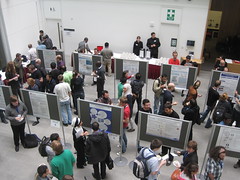
Throughout the conference, over 80 posters had been presented. This was an excellent opportunity for every student to engage in discussions with other students working on similar projects but also to get to know different aspects of the computer science research. And (if I may add) to understand that we are all on the same boat... fighting to find our spot in the community :P !! A competition among posters took place as incentive to contribute in this think tank. The competition ended with 11 finalists and 2 best poster winners. The good news is that three people from Aberdeen Uni made to the final. Two of them made dot.rural proud!! Andy with his poster on "Preventing Profiling in Competitive Communities" and Peter with "Alleviating stress by giving the perception of having a virtual teammate". Well done to them and to all the presenters!!

We closed with an inspiring talk of Prof. John Aycock on "Things they never taught me in grad school". Few tips to remember during the PhD: find an hobby that you are not good at, think after your Phd, and share your knowledge with the public!!

In conclusion, it was a great conference with great opportunities, great people and a lot of good FUNNN!!

A big thanks goes to SICSA and the organisers. And to the staff of Pollock Halls where we stayed.

Here some pictures from the conference...

- Conference moments:


- Pollock Halls:


- dot.rural Delegation


and few more from SICSA PhD Conference 2011 on Flickr:

- Poster sessions with Toni and Andy

Posters

- Prof. John Aycock on "A Phd Student crisis of faith"
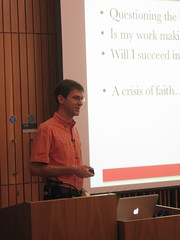
Prof. John Aycock - Keynote talk

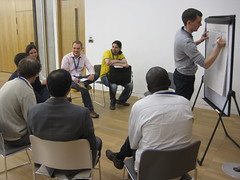
- Work in progress

Workshop

- Me desperately trying to defend my research... (I lost!)
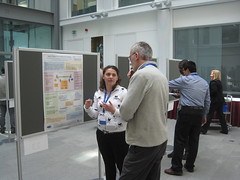
Posters


Alice with a big help from Andy, Peter and Toni

Wednesday, 25 May 2011

Riddle....

...3 days + 13 Scottish universities + over 100 Computer Science PhD students ...

...19 people + 5 months of organisation + 7 meetings + over 300 emails...

...4 keynote speakers + 10 workshops + 20 panelists...

...4 poster sessions + 80 posters + 11 finalists (2 dot.rural ...rocks!! ) + 2 winners...

...geeky discussions + pub + FUN...

….. = any guess??

….. it's the great SICSA PhD Conference 2011

More on this screen … when we will recover!!

Alice

Thursday, 14 April 2011

Highlands and Islands Enterprise Knowledge Transfer Network Event - 12th April

Event details:
The aim of this event was to showcase the Technology Strategy Board's (TSB) Knowledge Transfer Networks (KTNs) and opportunities for businesses and academics. There was also representation from Highlands and Islands Enterprise, the Scottish Funding Council, Scottish Enterprise and The Scottish Government.

I was interested in attending this event as I was keen on hearing more about KTN activity and the TSB in general. The first few sessions showcased KTNs from a TSB perspective and introduced the TSB's '_connect' website (ktn.innovateuk.org) that provides an opportunity to keep track of what each KTN is doing. I thought that the website in particular provided an excellent opportunity to keep up-to-speed with what is happening at TSB; you could also find people with specific expertise.

After the morning sessions we had to choose from one of three talks. I attended the discussion on digital healthcare, which included information on telehealth/telecare/m-health etc and had input from various KTNs including HealthTech and Medicines, Digital, Creative Industries and Electronics, Sensors, Photonics.

We then had lunch (sandwiches, wraps, sausage rolls, fruit salad - nice) and networked with other delegates. The day finished with a Q&A session with a panel...although only about half of the delegates were left which was a bit of a shame.

All in all, a good event. We handed out some info on Cafe Connect and a lot of people came to see us at our dot.rural stand - thank you v much to Nimbe for bringing all the showcase material on the train! We also took a couple of photos...


If you want to watch any of the keynote speeches then you can access them at:
http://dpdigitalmedia.co.uk/ktnlive.html

Alasdair

Friday, 18 March 2011

Satellites in Space: Launching Internet for Everyone!

National Science and Engineering Week 2011
Thursday 17th March 2011, King's College Conference Centre, University of Aberdeen

Last night's Satellites in Space event took us on a journey; from building satellites to shuttle launches, and back down to earth again with Internet service provision for rural areas.

Watch the full recording of the event here soon!

dot.rural’s Professor Gorry Fairhurst introduced presentations by four experts from the space and satellite industries before chairing the interactive audience Q&A session.


The panel of guest speakers included: Dr Taj Sturman (Senior Systems Engineer, Astrium Ltd) on how to build a satellite and launch it into space...


...Mr Paul Febvre (Satellite System Architect, Inmarsat Ltd) - the man with all the props!...


...Mr Graham Peters (Director, Avanti Consulting, Avanti Communications Ltd) asking how can satellites ‘up there’ provide universal Internet access ‘down here’?...


...and Dr Nick Race (School of Computing and Communications, Lancaster University) demonstrating the real social impact of Internet provision via the Wray case study...


This timely event marked the launch of dot.rural’s DART (Digital Advanced Rural Testbed) and SIRA (Satellite Internet Rural Access) projects.

The event was preceded by an informal exhibition of dot.rural projects, presented by Ruth, Nimbe, Leanne, Nico, Arjuna and Hien.

Hopefully, this one-off showcase will be followed by more public engagement opportunities and collaborations with these partners.

The events for National Science and Engineering Week continue until Sunday, including tonight's Bring Your Own Brain... but for dot.rural at least, its all over!

Three events later, ~150 members of the public engaged... and we're left wondering, what's the plan for next year?! :)
Claire

Thursday, 17 March 2011

Cafe Scientifique in the Shire - Can Technology be Persuasive?

National Science and Engineering Week 2011
Tuesday 15th March 2011, Woodend Barn, Banchory

For a special National Science and Engineering Week edition of Cafe Sci in the Shire, dot.rural's Hien Nguyen (Computing Science Research Fellow) asked 'can computers be persuasive?'.


Hien's interactive and free public talk formed part of the established Cafe Sci in the Shire programme and attracted an enthusiastic crowd of ~40 people.

Are the people of Banchory now more aware of dot.rural and the Digital Economy programme? Tick!

Do we have a better understanding of the thought processes behind Amazon's 'one click', and the Swedish piano staircase as an alternative to escalators? Tick!

Are we equipped to 'defend' ourselves against the more negative implications of persuasive technologies? Tick!

Do we now know how these technologies can be used for the better, particularly in the field of Healthcare? Tick!


For more information on the Cafe Sci in the Shire programme, or indeed on any of the other Cafe Sci events...

Cafe Sci in the City, Waterstones, Aberdeen: http://www.abdn.ac.uk/science/cafescience/CafeSci_CITY_2011_Season5.pdf
Cafe Sci in the Shire, Woodened Barn, Banchory: http://www.abdn.ac.uk/science/cafescience/CafeSci_SHIRE_2011.pdf
Cafe MED, Suttie Centre, Foresterhill, Aberdeen: http://www.abdn.ac.uk/science/cafescience/CafeMed_2011.pdf
Cafe Controversial, Satrosphere Science Centre, Aberdeen: http://www.abdn.ac.uk/science/cafescience/cafecontroversial_programme2010.pdf
Cafe Light, Lighthouse Museum, Fraserburgh: http://www.abdn.ac.uk/science/cafescience/CafeLight2010_programme.pdf

Great job Hien!
Claire

Tuesday, 15 March 2011

SpeedScience - scientists and the public interacting against the clock!

National Science and Engineering Week 2011
Monday 14th March 2011, Under the Hammer, Aberdeen

Last night's innovative Speed Science event proved a great success!

A brief insight into this unique event:
What happens when you take the quick-fire Speed Dating format and invite scientists to present their cutting-edge research in an exciting and innovative way? Can they beat the clock and impress you, to be voted the ‘winner’? Come along to this unique event to hear snapshots of science, before voting for your favourite researcher. You will get the chance to hear more from the ‘winner’ and join in with the lively discussion that follows. The clock’s ticking!

I’d like to thank the following people for their parts in delivering this: Alice, Andy, Chris B, Chris M, David, Gina, Lizzy, Peter, Hien, Rob, Ruth and Toni...


A special mention for, and congratulations to, Chris B (the ‘winner’ with 9 votes and also the birthday boy)...


to Ruth (2nd place with 5 votes)...


... and to Rob (3rd place with 4 votes).

The official University of Aberdeen photographer popped in, along with Laura Young & co (some RGU journalism students) to record the action for coursework. Watch the finished footage here.

Laura Young and the RGU camera crew...


Also, we had a surprise visit from STV! They filmed and interviewed for a short piece (watch it by clicking 'here' [2 mins in]). You can read their associated Speed Science article here: http://local.stv.tv/aberdeen/news/13149-speed-dating-for-scientists/

Mark Mathers (STV video journalist) capturing the magic...


In terms of public audience, I counted a whopping 47. I don’t think we could of hoped for more from a brand new format and venue... or had room for more!

The calm before the storm...


And SpeedScience in action...


The evaluation forms are positive, with a couple commenting on the periodic 'chaos' that ensued every time the researchers were buzzed on to the next table, and many overwhelmed by the “enthusiasm” in the room!

Looking forwards...
- Perhaps other researchers from within dot.rural would want to repeat this, in a month or two?
- Perhaps other research groups, of any discipline, across the University would want to take this and run with it? i.e. dot.rural could facilitate a regular series of these, opened out to all researchers at the University, but each one (say monthly) based on a different theme/topic... First Engineering, then Medicine, Ecology, Maths, Chemistry...
- Any thoughts on a 'Speed Science for Schools' version? I can feel another dot.rural schools tour coming on (uh-oh!). Every school has a canteen (tables and chairs are all that's required!) and the fast-paced, interactive and fresh format could really suit the younger audience...

And finally, Speed Science is the first of three dot.rural National Science and Engineering Week events taking place this week: http://www.dotrural.ac.uk/getinvolved

Speaking of other dot.rural NSEW events, I'm off to hear Hien's Cafe Sci in the Shire talk about computers being persuasive!

Big thanks to all those involved,
Claire

Wednesday, 9 February 2011

Grant Writing Workshop Launch

Myself and Ed attended the Grant Writing Workshop Launch on 26th Jan. Although it was a bit unclear as to what to expect (apart from a free lunch), the main part turned out to be a talk given by the principle (Prof Diamond) on his 13 points for grant writing. Everyone at the talk seemed to find them very useful, so I have listed them below as they may be of use to you in the future.


Professor Ian Diamond’s 13 Points for Grant Proposals

1. Discuss your brilliant idea with peers , formalize the problem, convince people that it is exciting, ground it in theory, make it clear.


2. Give an informal seminar on your idea, expanding audients to out-with immediate friends/peers


3. Ask yourself “can it really be done alone?”

* What help is required – is it single- or multi-disciplinary

* If multidisciplinary, you must be prepared to go outside of your comfort zone. Ask do you really need these people? Is there the correct chemistry between you?

* Ask yourself: can you/the others deliver on time; what’s their track record? Ask yourself: “Do I/the team have the skills to do what we are promising?”

4. Are initial results/pump priming (e.g. proof of concept) required for the grant?

5. Write the proposal

* Who to apply to? Research councils, charities; check their requirements and priorities. Speak to peers. Phone and talk to the organization about your idea.

* Structure of proposal:

- Form the problem properly; grounded in theory, describe context/framework your idea sits in

- What is the overall aim, the vision, and practical objectives

- How will it be done (research design) – scale, timing, resources; “don’t try to run before you can walk” regarding amount asking for – demonstrate that you can manage the project, and ensure you can deliver what you say you will in the timeframe (related to resources asked for)

6. Be clear what your research design will allow you to say about your results

7. Describe your methods clearly

* Ensure they are sensible; briefly describe why you did not chose other approaches; don’t be a “trust me, I’ll do it” person

* Data

- If require access to an existing data collection, you include necessary costs

- If collecting it, ensure you will make it open and available

- Demonstrate you know how you will analyse the data

8. Ethics – do you have/will seek/do not need ethical approach

9. Have you thought of all the difficulties that may arise while doing the research?

10. Is the bibliography reasonable? Ensure you have included the big names in the area and what they are doing

11. Are there any non-academic users of this research? Are there any co-funders?

12. Ensure dissemination activities (impact pathway) are included (both academic and non-academic if appropriate).

* Do you intend to co-produce work with relevant parties, or do you have intended beneficiaries? If so, they should be involved at the start.

13. May happen out of serendipity; in which case, should you are committed to take it forward if it does arise

14. Need an impact statement:

a. Demonstrate that the work has potential beneficiaries. Are beneficiaries involved?

b. If opportunities arise “serendipity”, how do you take the opportunities forward?

If successful in getting funded: deliver, deliver, deliver (what you said you would). Don’t stress about it if it doesn’t work out, as long as you can show the work was carried out properly.

If not successful, get a senior person to sit down with you, look at the grant proposal and the feedback, and resubmit/submit elsewhere. When resubmitting, including a covering note listing the changes.

Initial draft; David Corsar; 26/01/2011

Edited by; Edoardo Pignotti; 26/01/2011

David